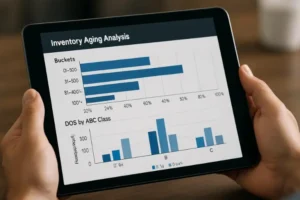

Inventory Ageing by Value: Why Not All Old Stock Carries the Same Risk
Inventory ageing is one of the most useful tools for understanding the health of a business’s stock. It helps companies identify how long inventory has remained in storage, which items are moving slowly, and where working capital may be getting blocked.
However, there is a common mistake in inventory analysis: treating every old stock item as equally risky.
A component that has been sitting in a warehouse for 12 months may still be essential for servicing machinery. A finished product that has been sitting for just three months may already be obsolete because of a change in customer demand, technology, or product specifications.
The age of inventory alone does not determine its financial risk.
Inventory ageing by value provides a more meaningful view by showing how much money is tied up in stock across different ageing categories. When combined with demand, usability, shelf life, and market value, it helps businesses identify which old inventory needs immediate attention.
For Indian manufacturers, distributors, wholesalers, retailers, and warehouse operators, this approach can improve inventory decisions, protect working capital, and reduce avoidable losses.
In this article, we explore why not all old stock carries the same risk and how businesses can use value-based inventory ageing to make better decisions.
What Is Inventory Ageing by Value?
Inventory ageing by value is the process of classifying stock according to how long it has been held and measuring the financial value of each ageing category.
Rather than looking only at the number of units, businesses examine the monetary value of the inventory.
For example, a warehouse may contain:
- 5,000 units of low-cost packaging material
- 200 units of expensive machine components
- 50 units of premium finished products
A unit-based ageing report may show that packaging material represents the largest quantity of old stock. However, a value-based report may reveal that the expensive machine components account for a much larger amount of capital.
This difference is important because inventory risk is not only about how many items are lying unused. It is also about how much money is invested in them.
Basic Formula
To calculate the percentage of inventory value in a particular ageing category:
This helps management understand the financial concentration of aged inventory.
1. Why Inventory Age Alone Can Be Misleading
Consider two items in an Indian manufacturing warehouse.
- Item A: A machine spare part that has been stored for 10 months.
- Item B: A finished product that has been stored for 4 months.
At first glance, Item A appears to be the older and riskier inventory.
But suppose Item A is required for maintenance of a critical machine and has a stable demand pattern. Item B, meanwhile, belongs to a product line that has been discontinued.
In this situation, Item B may carry a higher financial risk despite being much younger.
Inventory ageing should therefore be interpreted in the context of:
- Demand and consumption patterns
- Product lifecycle
- Shelf life and expiry
- Technical changes
- Customer commitments
- Replacement availability
- Net realisable value
- Storage and carrying costs
Ageing is a warning indicator. It is not, by itself, proof that inventory is obsolete.
2. Different Types of Old Stock Carry Different Risks
Not all aged inventory should be treated in the same way. Businesses need to distinguish between stock that is still useful and stock that is losing its economic value.
A. Slow-Moving but Usable Inventory
Slow-moving inventory has low consumption or sales compared with its available quantity.
Examples in India may include:
- Industrial components with occasional demand
- Electrical fittings used in specialised projects
- Packaging materials for less active product lines
- Furniture or fixtures with limited customer demand
This inventory may still be saleable or usable.
The risk is primarily related to excess quantity and the amount of working capital tied up.
Recommended action: Review demand forecasts, reduce future purchases, and evaluate whether the stock can be transferred to another location or used in upcoming orders.
B. Critical Spare Parts
Some inventory may remain unused for long periods because it is held for maintenance, emergency repairs, or operational continuity.
Examples include:
- Spare parts for manufacturing machinery
- Components for power equipment
- Replacement parts for specialised industrial systems
- Maintenance items for production lines
Such items may have low movement but high strategic importance.
A business that disposes of these items simply because they are old could face operational disruption later.
Recommended action: Assess criticality, lead time, replacement availability, equipment life, and maintenance requirements before taking action.
C. Obsolete or Discontinued Inventory
Obsolete inventory may no longer be required because of product discontinuation, changes in technology, revised specifications, or a decline in market demand.
Examples include:
- Old electronic components
- Discontinued consumer products
- Outdated model-specific spare parts
- Materials that no longer meet current specifications
This category may carry a higher risk of value loss.
Recommended action: Evaluate alternative usage, supplier return options, liquidation opportunities, and potential write-downs based on recoverable value.
D. Expiry-Sensitive Inventory
Expiry-sensitive stock requires a different approach because its value may decline sharply as its usable period reduces.
Examples include:
- Pharmaceuticals
- Food products
- Chemicals
- Adhesives and coatings
- Certain industrial consumables
A stock item with six months remaining before expiry may carry more risk than a non-expiring spare part stored for two years.
Recommended action: Track expiry dates by batch, use FEFO (First Expired, First Out), and establish alerts for approaching expiry.
E. Customer-Specific Inventory
Inventory procured or manufactured for a particular customer may remain unused if the project is delayed, cancelled, or specifications change.
Examples include:
- Custom fabricated parts
- Project-specific electrical components
- Special packaging
- Made-to-order materials
The risk depends on whether the stock can be sold or reused elsewhere.
Recommended action: Review customer commitments, cancellation terms, alternative demand, and recovery options.
3. Inventory Ageing by Value: An Indian Business Example
Let us consider a hypothetical Indian industrial distributor with a total inventory value of ₹1 crore.
The warehouse ageing report shows the following distribution:
| Inventory Age | Stock Value | Percentage of Total Value | Initial Risk View |
| 0–30 Days | ₹30 lakh | 30% | Generally healthy |
| 31–90 Days | ₹25 lakh | 25% | Monitor movement |
| 91–180 Days | ₹20 lakh | 20% | Review demand |
| 181–365 Days | ₹15 lakh | 15% | Higher exposure |
| 365+ Days | ₹10 lakh | 10% | Detailed review required |
| Total | ₹1 crore | 100% |
The report indicates that ₹25 lakh of inventory is older than 180 days.
However, management should not automatically assume that the entire ₹25 lakh is dead stock.
A detailed review may reveal:
| Inventory Category | Value | Business Context | Risk Level |
| Critical spare parts | ₹8 lakh | Required for equipment maintenance | Low to moderate |
| Slow-moving electrical components | ₹5 lakh | Demand exists but is limited | Moderate |
| Discontinued finished goods | ₹7 lakh | No current demand | High |
| Expiry-sensitive consumables | ₹5 lakh | Shelf life is reducing | High |
| Total | ₹25 lakh |
This analysis provides a better picture of the real risk.
The management team can prioritise the ₹12 lakh associated with discontinued goods and expiry-sensitive consumables while developing a separate plan for critical spare parts and slow-moving components.
The key insight: ₹25 lakh of aged inventory does not necessarily mean ₹25 lakh of inventory loss.
The actual exposure depends on how much value can be recovered, consumed, sold, or reused.
4. Why Inventory Ageing by Value Is More Useful Than Quantity Alone
A quantity-based report may show how many units are ageing. A value-based report shows the financial significance of those units.
For example, a business may have 10,000 units of low-cost packaging material and 100 units of expensive imported components.
If both categories have similar ageing, quantity alone may cause management to focus on the packaging material.
But the imported components may represent a much larger investment.
Value-based ageing helps businesses:
- Identify where working capital is concentrated
- Prioritise inventory reviews
- Focus on high-value stock exposure
- Identify potential valuation adjustments
- Improve purchasing decisions
- Support finance and supply chain discussions
- Establish more meaningful management reporting
A stronger report combines both quantity and value rather than choosing one over the other.
5. How to Build an Inventory Ageing by Value Report
A practical inventory ageing report should include the following information.
| Report Field | Purpose |
| SKU / Item Code | Identifies the inventory item |
| Item Description | Explains what the item is |
| Warehouse / Location | Shows where stock is stored |
| Quantity on Hand | Measures available units |
| Unit Cost | Determines inventory value |
| Total Stock Value | Shows capital invested |
| Last Movement Date | Helps identify inactivity |
| Receipt Date / Batch Date | Helps calculate stock age |
| Ageing Bucket | Classifies the item by age |
| Average Monthly Demand | Indicates consumption pattern |
| Months of Inventory Cover | Shows how long stock may last |
| Expiry / Shelf Life | Identifies time-sensitive risk |
| Open Customer Orders | Highlights committed demand |
| Estimated Recoverable Value | Supports financial risk assessment |
| Recommended Action | Converts analysis into decisions |
Step 1: Define the Ageing Basis
Businesses should clearly define how inventory age is calculated.
Possible bases include:
- Date of receipt
- Manufacturing date
- Batch date
- Last consumption date
- Last sales movement date
These dates serve different purposes.
For example, receipt date indicates how long stock has been held, while last movement date helps identify inactivity.
A warehouse transfer should not automatically make old stock appear newly received. The ageing logic must preserve the underlying inventory history.
Step 2: Create Suitable Ageing Buckets
A common starting point for non-perishable inventory is:
| Ageing Bucket | Typical Review Approach |
| 0–30 Days | Normal stock monitoring |
| 31–90 Days | Monitor demand and replenishment |
| 91–180 Days | Review slow-moving items |
| 181–365 Days | Evaluate excess and recovery |
| 365+ Days | Detailed risk and valuation review |
These are illustrative categories, not universal rules. Industry-specific thresholds should be used for FMCG, pharmaceuticals, fashion, manufacturing, project inventory, and critical spares.
Step 3: Calculate Stock Value by Ageing Bucket
This helps management identify which ageing categories hold the greatest financial exposure.
Step 4: Analyse Demand and Inventory Cover
Age alone does not reveal whether the available stock is excessive.
For example, a component that has been held for 180 days may still be appropriate if demand is predictable and the supplier lead time is long.
Inventory cover can be calculated as:
\[ \text{Months of Cover} = \frac{\text{Available Stock Quantity}}{\text{Average Monthly Demand}} \]
A stock item with 24 months of cover and no current orders may deserve a more urgent review than an older item with only two months of cover.
Step 5: Assess Recoverable Value
For potentially obsolete or damaged inventory, compare the recorded cost with its estimated net realisable value.
Net realisable value is generally the estimated selling price in the ordinary course of business, less estimated costs necessary to make the sale.
For accounting purposes, Indian inventory valuation requirements under applicable standards should be followed, including the lower-of-cost-and-net-realisable-value principle where relevant.
tallysolutions.com+1
The review should be supported by evidence such as:
- Recent selling prices
- Current customer demand
- Supplier return terms
- Alternative usage
- Repair or rework costs
- Disposal or liquidation value
6. How to Prioritise Inventory Risk by Value
An effective inventory review should not depend only on age buckets.
A practical approach is to combine inventory value with demand, usability, and recovery potential.
| Risk Category | Typical Characteristics | Recommended Action |
| Low Risk | Old but usable, stable demand, critical stock | Retain and monitor |
| Moderate Risk | Slow movement, excess quantity, recoverable value | Reduce replenishment, transfer or consume |
| High Risk | Discontinued, no demand, declining market value | Explore returns, liquidation or write-down |
| Urgent Risk | Expiry approaching, damaged or unusable stock | Immediate review and action |
This approach enables management to allocate time and resources where the potential financial impact is highest.
7. Common Mistakes in Inventory Ageing Analysis
Treating All Stock Older Than 180 Days as Dead Stock
A blanket rule may lead to unnecessary disposal of critical spares or strategically important materials.
Ageing thresholds should trigger a review, not an automatic write-off.
Reviewing Quantity Instead of Value
A high unit count may not represent the largest financial risk.
Management should examine both quantity and value.
Ignoring Demand and Inventory Cover
An old item with reliable demand may be healthy. A recently received item with no future demand may already be excess.
Using the Last Transfer Date Instead of True Age
Stock movements between warehouses can distort ageing reports if the system resets the item’s age.
Businesses should use a consistent and appropriate ageing basis.
Failing to Assign Ownership
An ageing report becomes ineffective if no one is responsible for taking action.
Each high-risk item should have an assigned owner, action, and review date.
Delaying Inventory Valuation Review
Old stock may remain recorded at its original cost even when its recoverable value has fallen.
Finance teams should review evidence and make appropriate valuation decisions under the applicable accounting policy.
8. How Indian Businesses Can Improve Inventory Ageing Control
Indian businesses operating across factories, warehouses, distributors, and retail locations can strengthen their inventory control through a structured process.
Establish Monthly Inventory Ageing Reviews
A monthly review can identify changes in ageing exposure before they become significant.
For high-turnover or expiry-sensitive categories, weekly monitoring may be more suitable.
Link Procurement With Ageing Data
Purchasing teams should review existing aged inventory before raising new purchase orders.
This helps prevent businesses from buying additional stock while usable inventory is already available.
Improve Coordination Between Departments
Inventory ageing should not be managed by the warehouse team alone.
The following teams should be involved:
- Procurement
- Sales
- Warehouse operations
- Finance
- Production planning
- Supply chain management
Each department contributes a different perspective on inventory risk.
Create an Action Tracker
A high-risk inventory tracker should include:
- Item code
- Stock value
- Ageing category
- Risk classification
- Root cause
- Action owner
- Proposed action
- Target completion date
- Current status
This turns inventory ageing from a reporting exercise into an operational improvement process.
Monitor Inventory Ageing KPIs
Useful KPIs include:
- Total inventory value
- Value of inventory older than 180 days
- Value of inventory older than 365 days
- Percentage of aged inventory to total inventory
- Slow-moving inventory value
- Obsolete inventory value
- Inventory turnover ratio
- Days inventory outstanding
- Inventory write-down value
- Recovery from aged inventory
The trend over time is often more useful than a single month-end snapshot.
9. The Role of Inventory Management in Working Capital Optimisation
Inventory is a significant component of working capital for many businesses.
When stock remains unused for extended periods, the money invested in that inventory cannot easily be used for other business activities.
This may affect:
- Supplier payments
- New procurement
- Production planning
- Business expansion
- Cash flow management
- Overall operational efficiency
Value-based inventory ageing helps businesses identify where working capital is tied up and whether that investment is justified by current and future demand.
However, the goal should not be to eliminate all old inventory. Businesses must maintain the right level of stock to support production, customer service, and operational continuity.
The objective is to identify unproductive inventory without compromising business operations.
Frequently Asked Questions
1. What is inventory ageing by value?
Inventory ageing by value classifies stock according to how long it has been held and calculates the financial value of each ageing category. It helps businesses identify where capital is tied up in older inventory.
2. Why is inventory ageing by value more useful than quantity?
Quantity indicates how many units are ageing, while value shows the financial investment associated with them. Value-based analysis helps management prioritise high-value inventory risks.
3. Does old inventory always mean dead stock?
No. Old inventory may still be usable, saleable, or strategically important. Critical spare parts, project materials, and items with predictable demand may remain valuable despite their age.
4. How can a business identify high-risk aged inventory?
Businesses should analyse inventory age alongside demand, stock cover, expiry dates, product lifecycle, customer commitments, usability, and estimated recoverable value.
5. Which ageing bucket should management focus on?
There is no universal threshold. Businesses often review inventory older than 180 days or 365 days, but the appropriate time period depends on the industry, item type, shelf life, and demand cycle.
6. How does inventory ageing affect working capital?
Aged inventory can tie up cash, increase carrying costs, and create potential valuation losses. Identifying excess or non-recoverable stock helps businesses make better working capital decisions.
7. How often should inventory ageing reports be reviewed?
Monthly reviews are a practical starting point for many businesses. High-turnover, seasonal, or expiry-sensitive inventory may require weekly or more frequent monitoring.
Conclusion: Focus on the Value at Risk, Not Just the Age of Stock
Inventory ageing is an essential part of effective inventory management, but the age of stock alone does not determine its risk.
A critical spare part stored for a year may still be valuable. A discontinued product stored for a few months may already represent a significant financial exposure.
By analysing inventory ageing by value and combining it with demand, usability, product lifecycle, and recoverable value, businesses can make more informed inventory decisions.
For Indian manufacturers, distributors, wholesalers, and retailers, this approach can help reduce excess stock, improve working capital utilisation, strengthen procurement planning, and support better financial control.