
Inventory is essential for business continuity, but holding more stock than necessary can quietly reduce profitability. Products that once sold regularly may begin to move slowly because of changing customer preferences, declining demand, product replacements, seasonal fluctuations, or inaccurate purchasing decisions.
When these products remain in storage for too long, they can eventually become dead stock—inventory that has little or no realistic prospect of being sold or consumed within a reasonable period.
The challenge is identifying slow-moving inventory early enough to take corrective action. Waiting until products become obsolete, expire, deteriorate, or lose market value can make recovery more difficult.
Businesses can address this problem by monitoring stock movement, reviewing inventory ageing, analysing demand patterns, and establishing clear rules for purchasing and replenishment. These practices help companies improve inventory visibility, release working capital, and make better use of warehouse space.
This guide explains how to identify slow-moving inventory before it becomes dead stock and how to build a practical process for managing it.
What Is Slow-Moving Inventory?
Slow-moving inventory consists of products or materials that sell, are issued, or are consumed less frequently than expected.
These items may still have some demand, but their movement rate is low compared with similar products or established business expectations.
For example, a distributor may normally sell 100 units of a product every month. If sales decline to 15 units per month while the warehouse continues holding 300 units, the inventory may be moving too slowly relative to demand.
Slow-moving inventory is not necessarily useless. Some products are required only occasionally, while certain spare parts or critical materials must remain available even when usage is infrequent.
The key is to determine whether the current stock quantity is justified by actual demand, lead times, operational requirements, and the consequences of a stockout.
Slow-Moving Inventory vs Dead Stock
Although these terms are related, they describe different inventory conditions.
| Factor | Slow-Moving Inventory | Dead Stock |
| Demand | Low but may still exist | Little or no realistic demand |
| Sales or consumption | Occasional movement | No meaningful movement for an extended period |
| Business usefulness | May still be useful | Often obsolete, redundant, or commercially unviable |
| Recovery potential | May be sold or consumed gradually | May require liquidation, return, recycling, or disposal |
| Recommended action | Investigate and control replenishment | Evaluate recovery options and write-off implications |
There is no universal number of days that defines slow-moving or dead stock for every business. The appropriate threshold depends on the product category, industry, demand cycle, shelf life, supplier lead time, and operational importance.
Why Slow-Moving Inventory Becomes a Business Problem
Slow-moving stock often begins as a purchasing or planning issue. If it remains undetected, it can develop into a broader financial and operational problem.
1. Working Capital Gets Locked in Unsold Stock
Money invested in inventory cannot be used elsewhere while the goods remain unsold. Excess stock can limit the funds available for fast-selling products, business expansion, supplier payments, and day-to-day operations.
Identifying slow-moving items helps management evaluate whether the capital invested in them is justified.
2. Storage and Handling Costs Increase
Inventory requires warehouse space, handling, recordkeeping, and sometimes special storage conditions. Products that remain in storage for extended periods continue consuming resources even when they generate little commercial value.
A regular stock review helps businesses identify items occupying space that could be used more productively.
3. Products May Become Obsolete or Expire
Technology changes, product redesigns, changing customer preferences, and regulatory requirements can reduce the usefulness or marketability of existing stock.
Perishable goods, chemicals, medicines, and other date-sensitive products face additional risks when inventory movement slows.
4. Purchasing Decisions Become Less Accurate
When businesses fail to identify existing slow-moving stock, purchasing teams may continue placing orders based on outdated assumptions or historical demand.
This creates a cycle in which new stock arrives while older inventory remains untouched.
5. Warehouse Efficiency Declines
Excess and inactive stock can make warehouse locations harder to manage, increase unnecessary handling, and reduce the space available for frequently required products.
Nilgriva highlights inventory accuracy, warehouse intelligence, inventory analytics, and working capital improvement as important areas of effective inventory control. These capabilities can help businesses establish better visibility into stock movement and inventory performance. (https://nilgriva.com/)
7 Ways to Identify Slow-Moving Inventory Before It Becomes Dead Stock
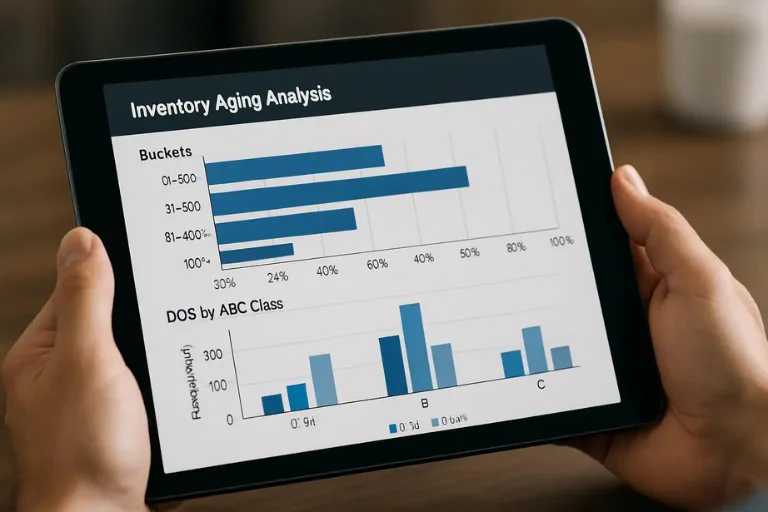
1. Review Inventory Ageing Reports
An inventory ageing report shows how long stock has remained in inventory or how long it has been since the last recorded movement, depending on how the report is configured.
Businesses can organise stock into ageing buckets such as:
- 0–30 days
- 31–60 days
- 61–90 days
- 91–180 days
- More than 180 days
These are illustrative categories, not universal industry standards. Businesses should adjust them according to product characteristics and normal demand cycles.
For example, 90 days without sales may be a serious warning for a fast-selling consumer product. However, it may be normal for an emergency spare part used only when equipment fails.
What to check:
- Stock that has remained in the warehouse beyond its expected holding period.
- Items approaching expiry or obsolescence.
- High-value products in older ageing buckets.
- Products with no sales or consumption during the review period.
- Large quantities held against low expected demand.
Reviewing both the age and value of inventory helps management prioritise the stock that poses the greatest financial risk.
2. Use FSN Analysis to Classify Stock Movement
FSN analysis groups inventory according to movement frequency:
- Fast-moving (F): Items sold or consumed frequently.
- Slow-moving (S): Items with limited or infrequent movement.
- Non-moving (N): Items with no movement within the defined review period.
This method helps businesses distinguish products that require regular replenishment from those that need closer monitoring or corrective action.
To perform FSN analysis:
- Collect sales, issue, consumption, and stock transaction data.
- Choose a relevant review period, such as six or twelve months.
- Calculate the movement frequency or average time between movements.
- Establish classification rules suitable for each product category.
- Classify items and review the slow-moving and non-moving groups.
- Assign an action to each item requiring attention.
The thresholds should be defined using business-specific demand patterns rather than applying the same rules to every product.
Nilgriva also discusses the role of FSN analysis in understanding inventory movement and improving stock control. Read its related guide on FSN Analysis in Inventory Management.
3. Compare Current Stock with Actual Demand
A product can appear to be moving because occasional sales occur, yet the quantity held may still be excessive.
For a simple first review, compare current stock with average monthly demand.
Illustrative example:
| Metric | Product A |
| Current stock | 240 units |
| Average monthly demand | 30 units |
| Approximate months of stock | 8 months |
| Normal target coverage | 2 months |
| Potential excess stock | 180 units |
In this example, eight months of stock is being held against a target of two months. The difference suggests a potential excess of 180 units, assuming demand remains stable and the target coverage is appropriate.
The basic calculation is:
Months of stock = Current stock ÷ Average monthly demand
For products with highly variable demand, use a more suitable forecast instead of relying solely on a simple historical average. Also consider committed orders, supplier lead times, minimum order quantities, safety stock, and seasonal demand before reducing stock.
4. Monitor Sales and Consumption Trends
Historical movement alone may not explain why inventory is slowing down. Businesses should examine how demand changes over time.
Compare recent sales or consumption with earlier periods and investigate products showing sustained declines.
Potential warning signs include:
- Falling monthly sales volumes.
- Repeatedly missed sales forecasts.
- Declining customer orders.
- Reduced production consumption.
- Products replaced by newer models.
- Seasonal demand that has not returned as expected.
A temporary decline does not automatically mean a product is becoming dead stock. Management should distinguish a short-term fluctuation from a lasting change in demand.
For example, an item may sell slowly during the off-season but experience strong demand during a predictable annual period. In such cases, inventory planning should account for the complete demand cycle.
5. Identify Products with No Recent Movement
Products that have not sold or been consumed for a defined period deserve closer investigation.
A no-movement report can identify items that have remained untouched for 30, 60, 90, 180 days, or another suitable threshold.
However, zero movement does not always mean an item is unnecessary. Certain safety-critical components, maintenance spares, and emergency supplies may have low usage but high operational importance.
For each item with no recent movement, ask:
- Is the product still active?
- Is there confirmed future demand?
- Is it required for maintenance, service, or contractual commitments?
- Has the product been replaced or discontinued?
- Is the stock quantity higher than the likely requirement?
- Can another branch or warehouse use the item?
These checks prevent useful inventory from being discarded simply because it has not moved recently.
6. Analyse Inventory Value Alongside Movement
Not every slow-moving item creates the same level of financial risk.
A low-cost item with limited movement may have little effect on working capital. A high-value item that has remained unsold for months may represent a significant financial exposure.
Combining movement analysis with inventory value helps management prioritise reviews.
| Stock category | Example situation | Suggested priority |
| High value, slow-moving | Expensive equipment held without confirmed demand | High |
| High value, non-moving | Discontinued product with no expected orders | Urgent review |
| Low value, slow-moving | Small quantities of inexpensive accessories | Routine review |
| Critical spare, low movement | Component needed to prevent equipment downtime | Review service risk before changing stock levels |
ABC analysis can complement FSN analysis by classifying stock according to its financial significance. Together, these methods help businesses evaluate both how frequently items move and how much capital is tied up in them.
7. Check Physical Stock and Inventory Records
Reports are useful only when the underlying data is reliable.
Incorrect stock balances, unrecorded issues, duplicate item codes, misplaced products, and delayed transactions can distort inventory ageing and movement calculations.
A product may appear inactive in the system even though it has moved physically. Conversely, the system may show available stock that cannot be located in the warehouse.
To improve accuracy:
- Conduct cycle counts for selected high-risk items.
- Reconcile physical quantities with system balances.
- Investigate unexplained stock differences.
- Standardise product codes and descriptions.
- Record receipts, issues, returns, and transfers promptly.
- Verify the last movement date against transaction records.
Physical stock verification and inventory reconciliation help establish a dependable foundation for inventory decisions. Nilgriva’s inventory solutions include stock verification, inventory reconciliation, cycle counting, and inventory optimisation support.
How to Create a Practical Slow-Moving Inventory Report
A structured report makes it easier for purchasing, warehouse, finance, and operations teams to act on the same information.
At a minimum, include the following fields:
| Report field | Why it matters |
| SKU or item code | Identifies the product consistently |
| Item description | Makes the stock easy to recognise |
| Current stock quantity | Shows how much is held |
| Stock value | Estimates the capital tied up |
| Last movement date | Highlights inactivity |
| Days since last movement | Supports ageing classification |
| Average monthly demand | Shows normal consumption |
| Months of stock | Indicates potential overstocking |
| Expiry or shelf-life date | Identifies time-sensitive risks |
| Open purchase orders | Highlights incoming supply |
| Confirmed customer demand | Helps assess realistic stock requirements |
| Recommended action | Assigns a clear next step |
The report should allow users to sort items by stock value, ageing, days without movement, or estimated excess quantity.
For example, a high-value item with no movement for six months and no confirmed future demand may deserve more immediate attention than a low-value product that sells occasionally.
What Should You Do After Identifying Slow-Moving Stock?
Identifying the problem is only the first step. The next step is choosing an action based on the cause, risk, and future usefulness of each item.
Stop or Reduce Unnecessary Replenishment
Review purchase orders, reorder points, and minimum order quantities for slow-moving items. Where appropriate, pause new orders or reduce replenishment quantities until existing stock is consumed.
Do not make changes without checking confirmed demand, supplier lead times, and operational requirements.
Transfer Stock to Another Location
Inventory that moves slowly at one branch may be in demand at another.
Review stock levels and demand across warehouses, stores, or business units before buying additional quantities. Internal transfers may help use existing stock more effectively.
Improve Sales and Demand Planning
Sales and procurement teams should investigate why demand has declined. Possible actions include updating forecasts, reviewing product assortment, aligning promotions with actual customer interest, and communicating product changes to purchasing teams.
Discounting can be appropriate for commercially viable products, but it should be evaluated against margins and likely recovery value.
Negotiate Returns or Alternative Uses
Where supplier terms allow, explore return arrangements, exchanges, or credit for eligible products.
Manufacturers may also be able to use certain materials in other products or production runs. Such options depend on technical compatibility, quality requirements, and contractual conditions.
Review Obsolete Stock for Disposal
If a product has no realistic future use, assess whether it can be liquidated, recycled, returned, repurposed, or disposed of responsibly.
Document approvals and follow relevant accounting, safety, environmental, and regulatory requirements. A disposal decision should consider the full commercial and operational context, not just the age of the stock.
How Often Should Businesses Review Slow-Moving Inventory?
Review frequency should reflect the speed, value, and risk of the products involved.
- Weekly: Fast-changing, perishable, high-risk, or high-value categories that need close monitoring.
- Monthly: Most routine inventory ageing and movement reviews.
- Quarterly: Broader policy reviews, recurring trends, and inventory optimisation initiatives.
These are practical starting points rather than fixed rules. A business should increase review frequency when stock is nearing expiry, product demand is changing quickly, or large financial exposures emerge.
Each review should record the identified issue, responsible owner, corrective action, expected completion date, and final outcome.
Common Mistakes to Avoid
Treating Every Slow-Moving Item as Dead Stock
Low movement is a warning signal, not proof that an item has no value. Critical spare parts and seasonal products may require deliberate stockholding.
Using the Same Ageing Threshold for Every Product
A universal 90-day rule can misclassify inventory. Define thresholds based on demand, product life cycle, shelf life, and operational importance.
Ignoring Incoming Purchase Orders
Businesses may identify excess stock but overlook additional inventory already on order. Review open purchase orders before making replenishment decisions.
Focusing Only on Quantity
A large quantity of a low-cost item may pose less risk than a small quantity of expensive, obsolete equipment. Evaluate stock value as well as volume.
Generating Reports Without Taking Action
A report delivers value only when it leads to decisions. Assign ownership, set deadlines, and track whether corrective actions reduce excess inventory.
Ignoring Inventory Record Accuracy
Unreliable stock records can lead to incorrect classifications and poor decisions. Reconciliation and physical verification should support the analysis.
Frequently Asked Questions
1. What is the best way to identify slow-moving inventory?
Start with inventory ageing and movement reports, compare current stock with actual demand, and use FSN analysis to classify items. Review stock value, expiry dates, open purchase orders, and operational importance before deciding on corrective action.
2. How many days without sales indicate slow-moving stock?
There is no universal threshold. A fast-moving retail product may require review after a few weeks without sales, while specialist equipment or critical spare parts may remain unused for much longer without being unnecessary. Set thresholds according to product behaviour and business requirements.
3. What is the difference between slow-moving and non-moving inventory?
Slow-moving inventory still sells or is consumed occasionally, whereas non-moving inventory has recorded no movement during a defined review period. Non-moving stock should be investigated, but it is not automatically obsolete or worthless.
4. How does FSN analysis help prevent dead stock?
FSN analysis categorises inventory by movement frequency. It helps businesses identify items that require routine replenishment, closer monitoring, or a detailed review for possible excess or obsolescence.
5. Which KPIs should businesses monitor?
Useful measures include inventory ageing, days since last movement, inventory turnover, months of stock, excess stock value, obsolete stock value, forecast accuracy, and stock record accuracy. The right combination depends on the business model.
6. Can slow-moving inventory be reduced without affecting customer service?
Yes, when decisions are based on reliable demand data and operational requirements. Businesses can adjust replenishment, transfer stock, improve forecasting, and remove unnecessary excess while protecting critical items and appropriate safety stock.
7. How can inventory audits help identify dead stock?
Physical stock audits and reconciliation can validate system quantities, identify discrepancies, and help confirm which products are actually available. Combined with movement and ageing analysis, they provide a stronger basis for decisions about excess and obsolete stock.
Conclusion
Slow-moving inventory rarely becomes dead stock overnight. It often develops through gradual changes in demand, excess purchasing, weak inventory visibility, or delayed decision-making.
Businesses can reduce this risk by reviewing inventory ageing, applying FSN analysis, comparing stock with realistic demand, monitoring products with no recent movement, and combining movement data with stock value and physical verification.
The most effective approach is not simply to reduce inventory. It is to hold the right stock, in the right quantity, for the right operational need.